New Orleans Ghost History: Why the City Is Called So Haunted
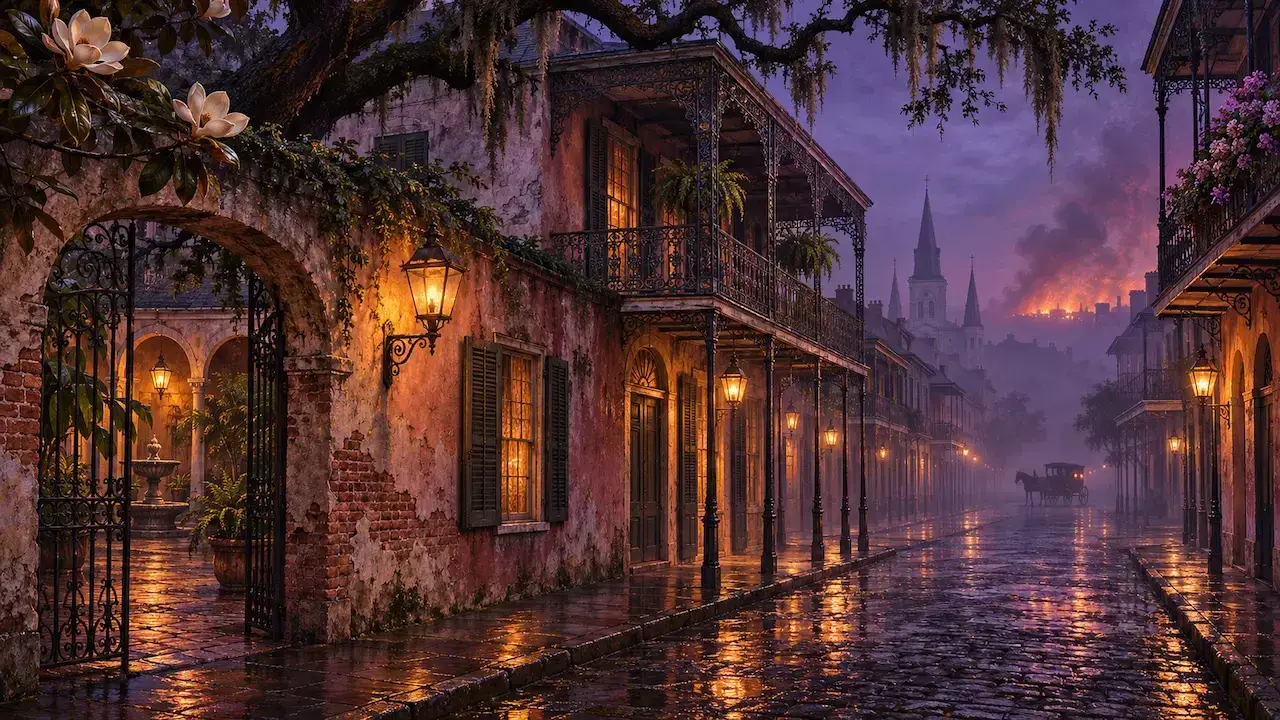
The short answer: New Orleans has so many ghost stories because it has so much of the kind of history people can't stop talking about. Fire, fever, and a city that kept rebuilding on top of itself.
Two fires in six years
On Good Friday, March 21, 1788, a fire swept through the city and destroyed 856 of its roughly 1,100 buildings, including the church, the town hall, and the jail. Much of the population was left homeless. Six years later, on December 8, 1794, another fire destroyed 212 buildings. That one is said to have begun when boys playing in a courtyard lost control of a fire in gusty wind.
The rebuilding is why the French Quarter looks the way it does. Spanish colonial officials replaced the old wooden French buildings with brick, courtyards, arcades, and wrought iron balconies. Much of the "French" Quarter is actually Spanish in style, which surprises a lot of people.
A century of yellow fever
Then the fever. Between 1817 and 1905, yellow fever came back to New Orleans over and over. In bad years, between July and October, it could kill as much as a tenth of the city, and about half the people who caught it died. The name comes from the jaundice that turned victims yellow.
It was nicknamed the "stranger's disease." People who grew up in the city were more likely to have survived a mild case as children, while newcomers, including many European immigrants, had no protection. A social divide grew up between the "acclimated" and the "unacclimated," and the city kept drawing newcomers anyway, because there was money to be made there.
The death toll is hard to pin down. One widely repeated estimate puts it around 41,000 for the 19th century, and 1853 is usually named as the worst single year. The city picked up another nickname too: Necropolis, the city of the dead. How all those people were buried is its own story, in Haunted New Orleans Cemeteries.
Buildings with many lives
After the fires and the epidemics, the buildings that survived or were rebuilt kept changing jobs. A ballroom became a convent and an orphanage. A site that may once have held a boys' school became a courthouse and then a hotel. Every new use is another layer, and every layer gives a story somewhere to attach. The best examples are in Haunted Hotels in New Orleans.
So is it haunted?
Whether or not anything lingers, the history alone explains the reputation. A city this small, this crowded, and this repeatedly broken was always going to fill up with stories.
The more useful question isn't "is it haunted?" It's "which of these stories can be checked?" That's the subject of Haunted New Orleans Stories: Which Parts Are True?, and the full map of the topic is in the Haunted New Orleans guide.
Meet the Chief
If you'd rather have fiction than folklore, meet Chief Marcus Thibodeaux, a New Orleans police chief and former quarterback who has spent too many years squinting into other people's lies. His origin story, The Golden Boy, is free when you join the list. His ongoing cases, including the ones where he calls in a tarot reader, are on the Patreon.
Where I got this
- How the Fires of 1788 and 1794 Changed New Orleans, The Historic New Orleans Collection, for the 1788 building counts and the rebuilding
- Great New Orleans Fire (1788), Wikipedia and Great New Orleans Fire (1794), Wikipedia, for the dates, the buildings lost, and the shift to Spanish-style construction
- 1788 Great Fire of New Orleans Remembered, Purple Media Network, which quotes historian Cindy Ermus on the homeless population
- Fire destroys much of New Orleans' French Quarter, History.com, for how the 1794 fire started
- How Yellow Fever Turned New Orleans Into the 'City Of The Dead', NPR, for the 1817-1905 range, the fatality rate, and the "acclimated" divide
- Is New Orleans America's Most Haunted City?, Ghost City Tours, for the 41,000 estimate and 1853 as the worst year (a tour company's history page, so treat the figure as an estimate)
Come a little closer.
Remy Blackwood is a New Orleans detective with something wild under his skin.
Share your email and The First Change finds you right away.
Free. Never spammy. Leave whenever you like.
