Werewolf Legends and Lore: Where the Wolf-Men Came From
Nov 01, 2026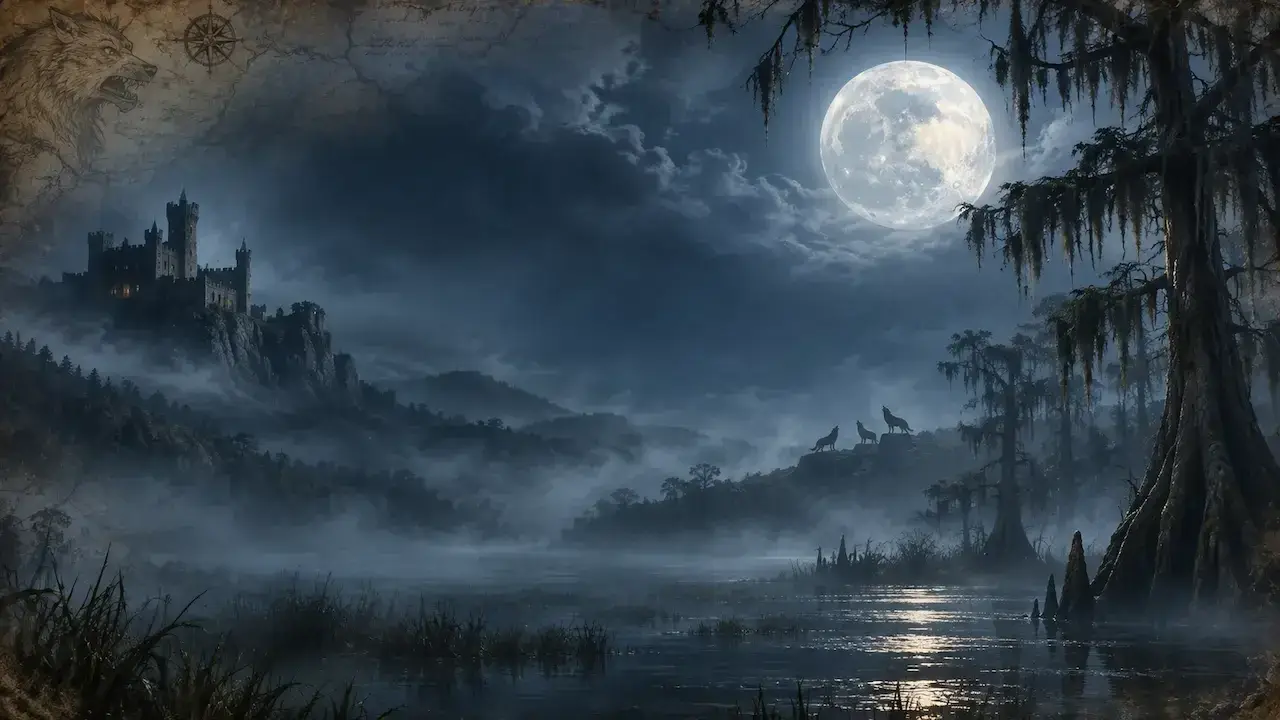
"Listen to them, the children of the night. What music they make!"
Bram Stoker, Dracula (1897)
Count Dracula says it to Jonathan Harker while wolves howl outside his castle. They are real wolves, not werewolves. The 1931 film kept the line, and Bela Lugosi's delivery made it famous. It's still the sound most of us hear in our heads when we think of the dark, the moon, and something hungry out there singing.
Werewolves are older than that line, older than movies, and a lot stranger than the romance aisle makes them look. This is a short map of where they came from.
The oldest wolf-men
The idea of a man turning into a wolf shows up in Ancient Greek stories. In one, a king named Lycaon is turned into a wolf as punishment, and the Greek word for wolf-person, lykanthropos, is where we get lycanthrope.
In the Middle Ages, the werewolf wasn't always a villain. The French poet Marie de France wrote a tale in the late 1100s called Bisclavret, about a nobleman who turns into a wolf and is betrayed by his wife. The reader is meant to feel sorry for the wolf.
Then the mood turned. By the late 1500s, werewolf trials were spreading through French- and German-speaking Europe, and the 1589 case of Peter Stumpp is often pointed to as a peak moment in that panic. Belief in the creature became a way to accuse real people of being monsters.
The French loup-garou
The French word for werewolf, loup-garou, literally says "wolf" twice, because garou itself came from an old word meaning man-wolf. That story, and how it relates to the English werewolf, is in Loup-Garou vs Rougarou vs Werewolf: What Is the Difference?
The one that still walks: the rougarou
French settlers carried the loup-garou to North America, and in south Louisiana it became the rougarou. In the old tellings it isn't a moon-struck monster at all. It's a punishment, most often for breaking Lent seven years in a row. People there still tell it, some of them in the first person. If you want the full story, start with What Is the Rougarou? The Werewolf Legend of Louisiana.
This is where I want to slow down, because it's the difference between a legend and a costume. The rougarou is a living part of a culture. People use it to make sense of what happens in the dark that they can't explain. That deserves respect.
What fiction did with it
Fiction took the wolf-man and made him a romance hero, a detective, a tragic figure, a hunter. Fear and attraction run through some of the same machinery in the body, which is part of why the alpha werewolf has so much pull on the page. Nothing wrong with that, and I write werewolf detective fiction myself.
I try to keep the line clear, though: Remy Blackwood is invented, and the legend underneath him is not. If you want the fiction, Remy's first story, The First Change, is free when you join the list.
Keep reading
- What Is the Rougarou? The Werewolf Legend of Louisiana
- Loup-Garou vs Rougarou vs Werewolf: What Is the Difference?
Where I got this
- Werewolf, Wikipedia, for the Greek roots and the 1589 Peter Stumpp case
- Dracula (novel), Wikiquote, for the Stoker line
- Dracula by Bram Stoker, Project Gutenberg, the full public-domain text
- Rougarou: The Swamp Werewolf, Terrebonne Parish Library, for the Louisiana legend
- Werewolf Words, Wordnik, for the word history
Get the free story
Remy Blackwood: The First Change. Join free and get your first story in your inbox today.
Free. No spam. Unsubscribe anytime.
