Fae Folklore: Types of Fae, Rules, and Old Bargains
From Celeste's notebook. Saturday, before the crowd.
Every night, before the first customer, I seat the room.
Nobody sees me do it.
I stand at the edge of the courtyard with my tarot deck wrapped in its silk cloth, watching the shadows stretch between the tables. The air smells of jasmine, spilled bourbon, and rain that hasn't fallen yet.
Then I decide who sits where.
Who gets the table by the door. Who belongs beside the fountain. Who I'd rather keep where I can see their hands.
And who, if I had any sense at all, I wouldn't let through the door.
I've done this long enough that it feels like instinct. But instinct is just another word for lessons you survived learning.
Tonight, the lessons arrive early.
Six beautiful strangers sweep through the courtyard together, laughing as though they've never had a sorrow in their lives. Their clothes shimmer beneath the gas lamps. One woman wears emeralds that catch the light like living things. Another has a laugh so infectious the bartender forgets what he's pouring.
They dance when the jazz trio plays. They leave coins in the fountain. One kisses the waiter on both cheeks and whispers something that makes him blush clear to his collar.
I give them the long table.
Trooping fae, I'd wager. They travel in company, and tonight they're feeling generous.
The trouble with a generous fairy is that you never know what she's giving you until you've accepted it.
Next comes a woman alone.
Gray coat. No jewelry. Hair pulled severely away from a face that might have been beautiful if she'd allowed it.
She sits with her back against the wall and orders nothing.
She watches the door.
Solitary fae are harder to read. They don't need an audience, and they rarely explain what they want.
I keep my eye on her.
Then comes a couple so exquisitely mannered they make everyone else in the courtyard look like they were raised in a barn.
The gentleman pulls out his companion's chair. She thanks him with a small inclination of her head. They address the waiter by his name, although I'm quite certain neither has been here before.
They will leave an enormous tip.
They will also remember, for the next hundred years, exactly who was rude to them tonight.
The Seelie are like that.
And then there's the man at the end of the bar.
He hasn't done a single thing wrong.
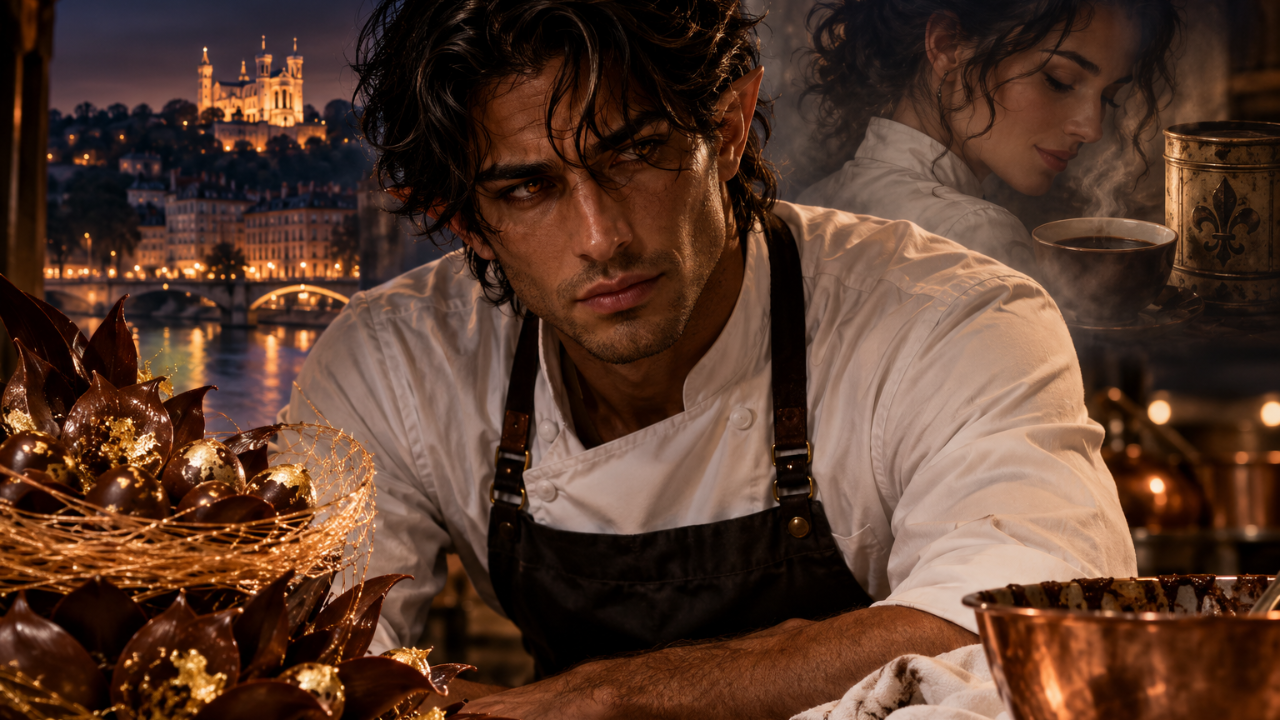
He's handsome in an unremarkable way, which is almost more troubling than if he'd arrived wearing a crown. His dark hair falls over his forehead. His shirtsleeves are rolled to the elbows. He's drinking something amber from a glass he hasn't lifted to his lips.
He watches the room without moving his head.
When the bartender asks whether he'd like another, the man smiles.
"No, thank you. I've had quite enough."
His voice is warm. Pleasant.
For some reason, the little hairs rise along my arms.
I turn my chair so I can see him.
That's the thing about the Fair Folk.
The dangerous ones don't always arrive with thunder and lightning. Sometimes they arrive smelling of expensive cologne, with perfect manners and a smile that makes you forget the question you meant to ask.
And if you're very unlucky, you won't recognize what you're dealing with until you've already made a promise.
What are the fae? The beautiful, dangerous history of the Fair Folk
The word fae sounds delicate, doesn't it?
A little breath of a word. Something that belongs in a garden among the roses.
The older stories weren't nearly so sweet.
Fairy, faerie, fae, and Fair Folk describe supernatural beings whose folklore stretches across centuries of European storytelling.
The word faerie comes through Old French, ultimately connected to the Latin fata, the Fates. In medieval English, faerie could describe an enchanted realm or enchantment itself before becoming a familiar name for its inhabitants.
Consider that for a moment.
Before a fairy was a creature, Faerie was somewhere you could go.
And the old stories spent a remarkable amount of time warning people not to go there.
The Irish called them the Good People. In Scottish tradition, they might be the Good Neighbors. The Welsh spoke of the tylwyth teg, the Fair Family.
Those names weren't necessarily compliments.
They were precautions.
You called them something pleasant because you didn't want to attract their displeasure.
Southern grandmothers understand this perfectly. There's a particular way a woman can call someone sweetheart that tells you you're about to have a very bad afternoon.
The Fair Folk have been practicing that trick for centuries.
Where did the fae come from?
Ask five folklorists where fairies came from, and you may get six answers.
Ask a fairy, and she'll probably tell you whatever suits her.
European traditions offered several competing explanations.
Some believed the fae were fallen angels, cast out of heaven but not condemned to hell.
Others described them as spirits of the dead, wandering between worlds, still connected to the living through memory, blood, and unfinished business.
In Irish mythology, the Tuatha Dé Danann became closely associated with the sídhe, the mysterious otherworld and the ancient mounds beneath which supernatural beings were said to dwell.
Imagine walking through green Irish countryside and passing a hill that has stood untouched for centuries.
The grass is thick. The wind is warm. The birds are singing.
And nobody in the village will build a house there.
Not because the hill is empty.
Because they believe it isn't.
In 1691, the Scottish minister Robert Kirk described fairies as a mysterious middle order of beings in The Secret Commonwealth of Elves, Fauns and Fairies.
Neither quite human nor angel.
Something occupying the spaces between.
Other historical writers were considerably less charitable. King James VI of Scotland, later James I of England, associated such supernatural beings with demonic deception in his Daemonologie of 1597.
And some nineteenth-century writers proposed that fairy legends preserved memories of earlier human populations. Those speculative explanations are not accepted as established historical accounts today.
There has never been one universally accepted origin story for the fae.
Which, I suspect, is exactly how they would prefer it.
Types of fae: Who's dancing, who's watching, and who's dangerous?
Not all fairies belong to the same company.
Some travel in magnificent processions. Some haunt lonely places. Some attach themselves to households, waterways, or particular families.
And some seem perfectly content to ruin your evening for no reason you can understand.
Over the centuries, folklorists developed different ways of classifying them.
The trouble is that fairy folklore wasn't written by a single author. It grew out of countless local traditions, and the categories overlap.
Still, a few distinctions are worth knowing.
Especially if you're accepting invitations after dark.
Trooping fae: The beautiful ones who travel together
W. B. Yeats described Irish fairies as belonging broadly to two groups: trooping and solitary.
The trooping fae are the social creatures.
They gather in companies, dance beneath the moon, feast in hidden halls, and move through the countryside in splendid processions.
They are the fairies of music and celebration.
You can almost hear them, can't you?
A fiddle somewhere beyond the trees. Laughter carried on the wind. The unmistakable sound of a party to which you haven't been invited.
Perhaps you follow the music.
Perhaps a beautiful stranger takes your hand.
Perhaps you dance until dawn.
And perhaps, when you finally stumble home, you discover that everyone you ever loved has been dead for a hundred years.
Time doesn't always behave itself in fairyland.
Neither do the guests.
Solitary fae: The ones who prefer their own company
The solitary fae don't require a court, a procession, or a ballroom.
They occupy the lonely edges of the world.
The leprechaun, the familiar Irish figure associated with shoemaking and hidden treasure, belongs among the solitary fairies in Yeats's classification.
So does the banshee, whose lament warns of death within a family.
These beings aren't necessarily part of some grand supernatural conspiracy.
They have their own business.
Their own territories.
Their own reasons for wanting you gone.
Personally, I find the solitary ones more unsettling.
A crowd can distract itself.
A creature that has waited alone beside the same stream for three hundred years probably knows exactly why you're there.
Even if you don't.
The Seelie Court: Beauty, manners, and dangerous generosity
In Scottish folklore, the Seelie Court represents a company of fairies traditionally regarded as more favorably disposed toward humans than their darker counterparts.
Seelie carries associations with happiness, blessing, or good fortune.
But don't confuse more favorable with safe.
A Seelie fairy might reward kindness.
She might help someone who has shown her hospitality.
She might even fall in love with a mortal.
But slight her dignity, break your word, or refuse a gift in the wrong manner, and the evening can turn unpleasant.
Imagine being courted by someone breathtakingly beautiful.
He remembers your favorite flowers. He sends gifts that arrive without a messenger. He knows your dreams before you've told him.
Every word out of his mouth is exquisite.
Then one evening, while you're standing beneath a flowering magnolia, he asks you for a promise.
Just one little promise.
And because he's beautiful, because he's been so very kind, because you want him to look at you that way again—
You say yes.
Darling.
I hope you asked what he meant.
The Unseelie Court: When the beautiful stranger means you harm
The Unseelie Court occupies the darker side of Scottish fairy tradition.
Its members are associated with hostility, misfortune, and supernatural danger. Unlike the more favorably regarded Seelie, they need not wait for a human insult before causing trouble.
Later fantasy literature expanded these old distinctions into elaborate rival courts, with kings, queens, politics, and intrigues.
The historical folklore was less tidy.
There wasn't a universal rulebook dividing every fairy into two competing kingdoms.
But the distinction makes for a useful warning.
Some beings might help you if you treat them respectfully.
Others won't.
And the worst of them may enjoy allowing you to believe you're safe.
I've devoted an entire notebook entry to the darker company: Dark Fae Folklore: The Unseelie and Who Not to Invite In.
Read it before you accept an invitation from anyone whose reflection seems a little too slow to follow.
Other fae: Household spirits, water maidens, and creatures of the hills
The old fairy world is larger than two courts and a handful of familiar creatures.
In 1880, Wirt Sikes organized Welsh fairy traditions into categories that included woodland beings, household spirits, and supernatural figures associated with lakes and mountains.
Robert Hunt collected Cornish traditions involving pixies, household spirits, and other strange inhabitants of the landscape.
Modern folklore scholars caution that these categories were never universal. Local storytellers didn't necessarily agree about what belonged where.
That doesn't surprise me.
I've been watching supernatural creatures come through my courtyard for years.
I've yet to meet one who appreciated being told what category he belonged in.
What do fae look like? Forget the butterfly wings
If your picture of a fairy involves a tiny blonde woman in a flower-petal dress, I have some disappointing news.
That image owes a great deal to later art, children's literature, and Victorian imagination.
Older fairy traditions were considerably more flexible.
Fairies might appear human-sized. They might be impossibly beautiful, grotesque, elderly, youthful, or capable of changing their appearance altogether.
Some appeared as splendid nobles.
Others as little household creatures.
Some could vanish.
And many traveled through the air without anything resembling the butterfly wings that became popular in later illustrations.
Which raises an interesting problem.
If a fae can look like anyone, how do you recognize one?
You watch what they do.
The old stories are full of unusual behavior, peculiar demands, enchanted music, altered time, and bargains that carry consequences long after the encounter has ended.
Beauty is not proof of goodness.
Ugliness is not proof of evil.
And a charming smile tells you precisely nothing.
I wish more women understood that last one before they started dating.
The three fae rules: Don't eat, don't promise, don't owe
Fairy folklore is full of warnings about accepting gifts, visiting supernatural places, speaking carelessly, and entering agreements whose terms are not what they seem.
Not every tradition shares the same rules. The familiar modern lists are often assembled from stories that originated in different places and centuries.
But in my notebook, I've reduced the warnings to three.
Don't eat what they offer.
Don't say what you can't afford to mean.
Don't owe what you can't repay.
That first rule comes from the many old stories in which accepting supernatural food creates a dangerous attachment to the otherworld.
In some tales, eating fairy food means you cannot easily return home.
The second is about words.
Names, promises, invitations, and careless declarations can acquire extraordinary weight in folklore and fantasy.
The third is about debt.
A favor may be freely offered.
That doesn't mean it comes without expectations.
And nothing complicates a romance quite like discovering that the man who saved your life considers the matter an engagement.
I've written a longer explanation here: Fae Rules: What Not to Eat, Say, or Promise.
Read it.
Especially the part about promises.
Changelings and the terrifying folklore of stolen children
Not every fairy story is romantic.
Some are heartbreaking.
Across parts of Europe, people once feared that supernatural beings could steal human infants and leave strange substitutes in their cradles.
These substitutes were called changelings.
The stories described children who seemed suddenly different, failed to thrive, cried incessantly, or behaved in ways their families couldn't explain.
In other tales, new mothers were taken to nurse fairy children, or adults vanished into supernatural realms.
These beliefs carried terrible real-world consequences.
Historical accusations involving changelings sometimes resulted in abuse and death, particularly affecting vulnerable children and adults.
It's important to remember that these weren't merely charming stories told beside the fire. People sometimes acted on them.
I've treated that history separately, and with the care it deserves, in Changeling Folklore: The Stolen Child Stories.
Because even when we're writing about magic, we owe the people who suffered under these beliefs the truth.
Fae romance: The supernatural lovers who came before modern fantasy
Now, this is where the stories become interesting.
Long before modern romantasy filled our bookshelves with dangerous immortal lovers, medieval storytellers were already writing about beautiful supernatural beings who wanted human companions.
Sometimes they wanted love.
Sometimes obedience.
And sometimes the distinction was alarmingly difficult to establish.
Consider Tam Lin.
A young woman named Janet becomes involved with a mysterious man held under the power of the Queen of Faerie.
To save him, she must face terrifying transformations and refuse to surrender her hold on him.
Or Thomas the Rhymer, whose encounter with the Queen of Elfland takes him into a supernatural realm for seven years.
Then there's Oisín, the Irish hero who travels with Niamh to Tír na nÓg, the Land of Youth.
When he finally returns to Ireland, centuries have passed.
He has lost the world he knew.
And when the enchantment sustaining his youth is broken, age comes for him all at once.
In the medieval romance Sir Orfeo, a king uses his music to reclaim his wife from the King of Faerie.
Love. Captivity. Impossible bargains. Beautiful supernatural rulers.
Tell me that doesn't sound like the beginning of a modern fantasy romance.
The difference is that the old storytellers weren't always interested in giving their lovers a happy ending.
Which brings me to a question I've been considering for years.
If an immortal creature falls in love with someone who will live only a few decades, is that romance?
Or is it a particularly exquisite form of cruelty?
I haven't decided.
If you're fond of supernatural men who make exceptionally bad decisions look tempting, I've collected some reading suggestions in Fae Romance Books: A Reading List Sorted by Heat Level.
Consider it research.
Fae folklore in New Orleans: Where old bargains find new homes
New Orleans has never been particularly concerned with keeping its stories separate.
French, Spanish, African, Caribbean, Indigenous, and later immigrant traditions have all contributed to the city's extraordinary cultural history.
But that doesn't mean every supernatural tradition belongs to the same belief system.
The European fairy traditions I've described here have their own histories.
Louisiana's African diasporic spiritual traditions, local ghost stories, Catholic folk practices, and Indigenous beliefs deserve to be understood on their own terms, not casually relabeled as fairy lore.
I keep those histories on different shelves in my notebook.
You can explore more of them in New Orleans Folklore and Legends: Spirits of the Quarter and the Bayou.
But this is New Orleans.
And in the New Orleans I write about, supernatural beings have been borrowing one another's streets for a very long time.
The old European courts don't necessarily operate here as they did across the Atlantic.
Territory matters.
Hospitality matters.
And the person holding the most power in a room isn't always the one who appears to be in charge.
A court isn't necessarily a castle.
Sometimes it's a table beneath a courtyard balcony.
Sometimes it's a restaurant kitchen.
And sometimes it's a gathering of beautiful strangers who have come to collect a debt incurred generations before anyone currently living was born.
The trick is figuring out who is owed what.
Preferably before somebody starts bleeding.
The man at the bar
From Celeste's notebook. Later that night.
By eleven, the courtyard is full.
The trooping company has ordered another bottle of champagne. The solitary woman in gray has vanished without anyone noticing her leave.
The exquisitely mannered couple has paid their bill.
The waiter is staring at the tip they've left him.
I tell him not to spend it until morning.
He laughs.
I don't.
And the man at the bar is still there.
His drink remains untouched.
When I finally gather my cards and prepare to leave, he rises from his stool.
He's taller than I expected.
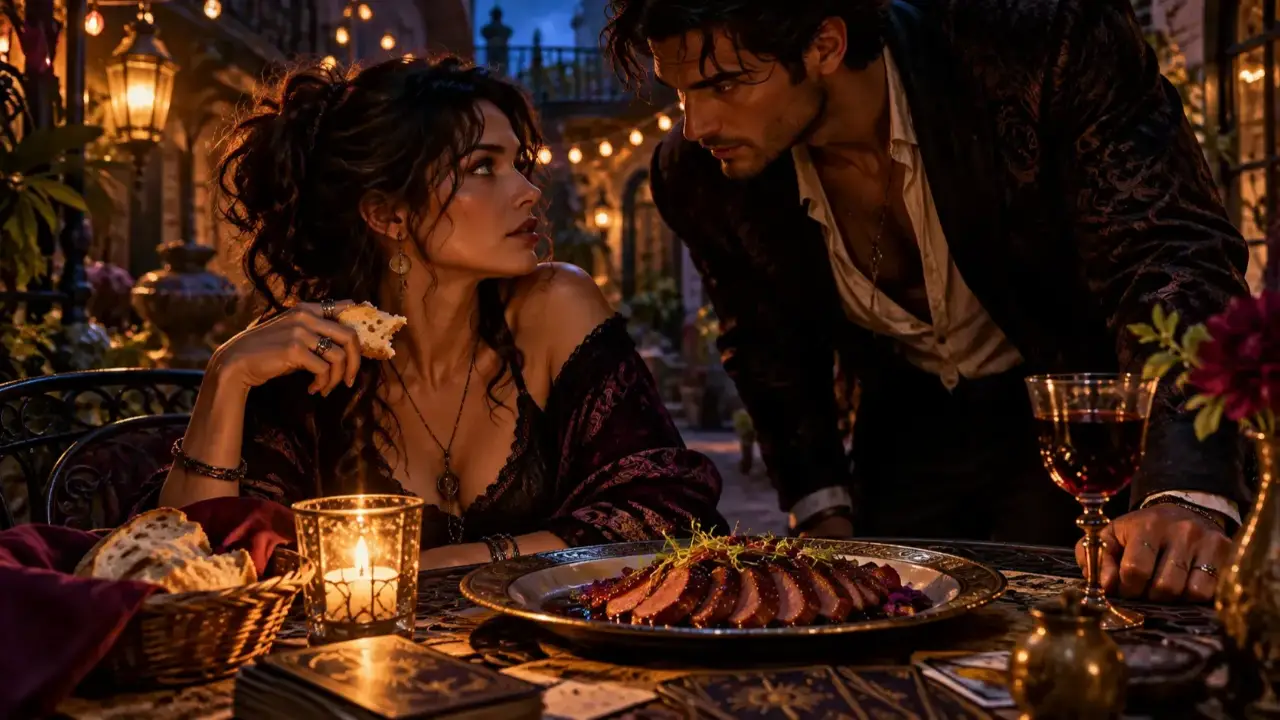
He crosses the courtyard without hurry, stopping just beyond the reach of my little table.
"Good evening," he says.
"Depends who's asking."
His smile deepens.
"I wondered whether you might do me a small favor."
There it is.
The first hook.
"What kind of favor?"
He looks toward the fountain, where a few coins glitter beneath the water.
"I'm looking for someone."
"Lots of people are."
"She's been hiding from me for a very long time."
Something in his voice makes me look up.
Not anger.
Not quite longing.
The patience of a man who has never once considered that he might run out of time.
"And you think I know where she is?"
"I think," he says softly, "that you know considerably more than you pretend."
He reaches into his coat.
For one extraordinary second, the music stops.
Not the musicians.
The music itself.
As though someone has placed a hand over the mouth of the night.
Then he sets a single gold coin on my table.
Old.
Worn.
Stamped with the face of a king I don't recognize.
"For your trouble."
I look at the coin.
Then at his hand.
Then into those perfectly ordinary, perfectly beautiful eyes.
"No, thank you."
He studies me.
"Are you certain?"
"Quite."
A long silence.
Then he laughs.
Not cruelly.
Almost admiringly.
"How refreshing."
He takes back his coin.
"Perhaps another evening, then."
"Perhaps."
He inclines his head and walks away.
Only after he's disappeared through the courtyard gate do I realize that the fountain has stopped running.
I sit very still.
Then I unwrap my deck.
There are seventy-nine cards inside.
There should be seventy-eight.
The extra card is blank.
Except for three words, written in a hand I know I've seen before.
You owe me.
Well.
Shit.
More stories from Jasmine & Rain
Some of the people in these notebooks are entirely fictional.
Some of them have been dead for centuries.
And some of them would be deeply offended to discover that I've been writing about them.
Welcome to Jasmine & Rain Stories, a world of Southern Gothic fantasy, dangerous bargains, supernatural romance, and things that go bump in the French Quarter.
If you'd like to know what happens next, join the Jasmine & Rain newsletter.
You'll receive stories, excerpts from Celeste's notebooks, and glimpses into a New Orleans where the beautiful stranger at the next table might be considerably older than he looks.
For readers who prefer to get into trouble early, Jasmine & Rain Stories on Patreon offers story installments a week before their public release.
Bring your curiosity.
Keep your promises.
And for heaven's sake, don't accept any mysterious gold coins.
Folklore sources and further reading
The supernatural traditions behind these stories are older, stranger, and more varied than any single fictional world can capture.
For readers interested in separating historical folklore from the liberties I take with it, these are useful places to begin.
Katharine Briggs, An Encyclopedia of Fairies (1976). An extensive reference on British and Irish fairy traditions, supernatural creatures, and the customs associated with them.
Robert Kirk, The Secret Commonwealth of Elves, Fauns and Fairies (written 1691). A fascinating early account of Scottish supernatural beliefs. The text is in the public domain.
W. B. Yeats, Fairy and Folk Tales of the Irish Peasantry (1888). A collection of Irish stories and traditions, including the distinction between trooping and solitary fairies.
Wirt Sikes, British Goblins (1880). A detailed nineteenth-century collection of Welsh fairy traditions and classifications.
Robert Hunt, Popular Romances of the West of England (1865). A collection of Cornish folklore, including tales of pixies, spirits, and supernatural encounters.
Traditional ballads and romances: Tam Lin, Thomas the Rhymer, and Sir Orfeo are essential reading for anyone interested in the complicated history of mortal love and supernatural power.
For introductory reference material, see Fairy and Classifications of Fairies.
Celeste's three rules are her own synthesis of recurring folklore motifs, not a historically universal code followed by all fairy traditions.

Responses